Virtue-Free Education—Long Live the Democracy!

It might go without saying, but I’m going to say it anyway to make sure we are all on the same page—modern American education is based upon a progressive worldview. This model of education is used almost wholesale in the Government (aka “Public”) schools and appears to be the most prevalent model in private (even Christian private) schools. One important difference in the educational approach … Continue reading Virtue-Free Education—Long Live the Democracy!

Knowledge Crawling Over My Skin (The Regime #3)

“I seemed to have wandered my way back to the beginning—not just of the book, but of the world—and all the rest was yet to come. I felt knowledge crawl over my skin.”[1] Thus says Wendell Berry’s title character in his meandering reflection on life in the midwest in the mid-20th century, Jayber Crow. Jayber had come to reject the Christian teaching of the seminary … Continue reading Knowledge Crawling Over My Skin (The Regime #3)

The Cave as the Model of Education: A Satire (The Regime #2)

A satire written in the vein of Anthony Esolen’s 10 Ways to Destroy the Imagination of Your Child or perhaps C. S. Lewis’ Screwtape Letters. Recently, in clearing the books out of our school library, I came across a book by Plato called The Republic. I was about to throw the book away with the others, when I noticed a tab at the beginning of … Continue reading The Cave as the Model of Education: A Satire (The Regime #2)

How to Walk Upside Down, Sideways, and at an Angle (Tread the Dawn Series)

This is the launch of a news series of blogs called “Tread the Dawn”. The blogs in this series are inspired by C.S. Lewis’ Voyage of the Dawn Treader. Have you ever hung upside down with your feet attached to the floor? What about straight sideways, yet maintaining a standing position? What about an angle somewhere between upside down and straight out? These may sound … Continue reading How to Walk Upside Down, Sideways, and at an Angle (Tread the Dawn Series)

Burn Before Reading (and Other Activities to do with History Textbooks)

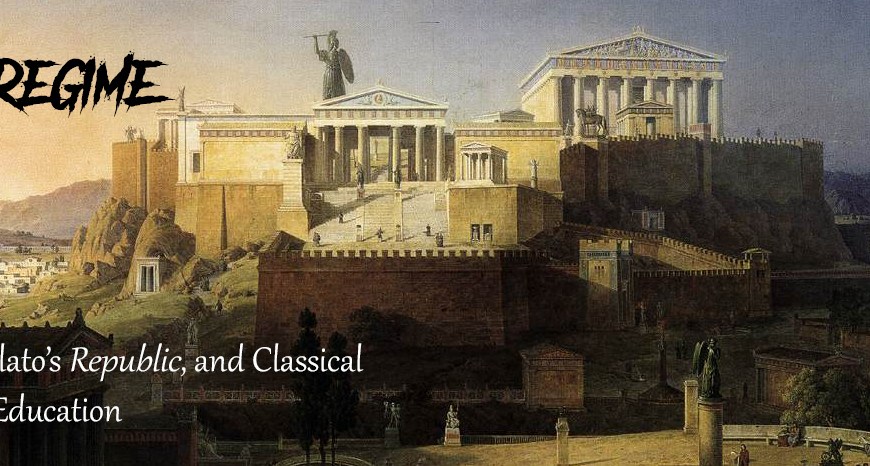
This blog will serve as the introduction to a new series of blogs that I will be producing over the next several weeks. The series is called The Regime[1]. It will be focused on applying the dialectic of Socrates in Plato’s Republic to classical Christian education. For those familiar with the Republic, you may see how the below relates to the allegory of the cave. … Continue reading Burn Before Reading (and Other Activities to do with History Textbooks)

The Hidden Dangers of Spa Water

The following is an analogy to consider for those who have their kids in government or secular schools. This analogy is intended for those who might raise the objection that if they can teach their kids what things to avoid (e.g. Evolution) then there is no real danger for their children in the public/government/secular schools. I hope that this analogy helps illustrate the flaw in … Continue reading The Hidden Dangers of Spa Water

Stop Loving People, Part 3: So What’s the Problem?

In the last blog, Stop Loving People, Part 2, I had us consider three points about love: 1. God’s particular love; 2. that the abstraction of “people” leads to non-love; 3. and that God has placed particular people in your schools and lives to love. In part 3, we will now consider the question: So what’s the problem with not loving in a particular way? … Continue reading Stop Loving People, Part 3: So What’s the Problem?

Education in the Storm

By Josh Dyson, Classical School of Wichita Education in the Storm: An Encouragement to Parents in the Aftermath of Hurricane Harvey As a native Texan I right now sit 500 miles away from my hometown of Houston. And having lived through the flooding of tropical storm Allison, I remember how bad things can get. From what I am told those conditions were surpassed less than … Continue reading Education in the Storm

No One Mourns the Virtuous

By Josh Dyson, Director of Operations at the Classical School of Wichita We live in a world today where virtue is either redefined or called into question whether it exists at all. One tenant of postmodernism is that truth in any universal sense is unknowable and therefore irrelevant. Thus the argument goes that we cannot evaluate truth claims but rather must deal in contexts, “texts”, … Continue reading No One Mourns the Virtuous

Freedom in the Fire–Fahrenheit 451

by Josh Dyson, Classical School of Wichita Montag: ”I don’t want to change sides and just be told what to do. There’s no reason to change if I do that.” Faber: ”You’re wise already!” The dialogue above between Montag, the protagonist, and Faber, the wise sage, in Ray Bradbury’s 1953 dystopian novel, Fahrenheit 451, takes place in the middle of Montag’s crisis of belief. He … Continue reading Freedom in the Fire–Fahrenheit 451

Stop Loving People, Part 2

By Josh Dyson, Classical School of Wichita If you have not done so, I encourage you to read the introduction to this series, Stop Loving People, Part 1. In this series of blogs we will consider the following: 1. God’s particular love; 2. that the abstraction of “people” leads to non-love; 3. and that God has placed particular people in your schools and lives to … Continue reading Stop Loving People, Part 2