How Do We Educate Towards Virtue?

I have suggested in a previous post (Head, Heart, and Hands) that as classical Christian educators we are aiming to produce students of wisdom and virtue. More specifically, I have suggested that we are educating for “re-humanization;” that is, training, teaching, and discipling students to reflect the image of God in which we were created and to which we will one day be glorified. Classically, seven … Continue reading How Do We Educate Towards Virtue?

Seven Laws of Teaching

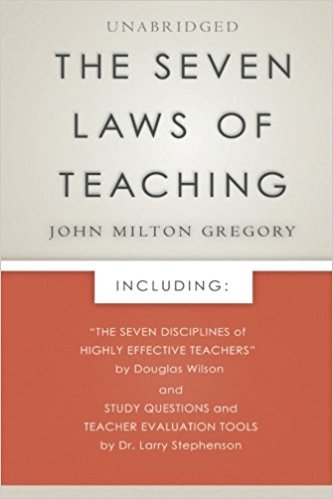
One work that has received significant attention in classical Christian schools is The Seven Laws of Teaching by John Milton Gregory.[1] In this work, Gregory lays out seven laws and explains why they are helpful guidelines for teaching effectively. The work, first published in 1886, predates modern ideas of education and therefore serves as a helpful “return” to what classical Christian educators believe is a … Continue reading Seven Laws of Teaching

An Education of the Head, Heart, and Hands

Classical Christian education is often said to be a pursuit of the good, the true, and the beautiful. Others have built upon this idea to say that we are aiming to produce wisdom and eloquence in our students. Still further, classical Christian education has been said to be an exploration and instillation of virtue. Likely the most common statement regarding the goals of classical Christian … Continue reading An Education of the Head, Heart, and Hands

The Journey

Not surprisingly, the journey is perhaps the theme more than any other at the heart of the Great Books of literature. The Odyssey, The Divine Comedy, The Canterbury Tales, and many more are centered upon a journey, a journey that changes the characters for both good and ill. I think as Christians we do well to read these journeys, to enter into them along with the characters and learn as they learn, to learn what they learn, and oftentimes learn the lessons how they learn them. In the following examples, I want us to journey together to learn alongside the characters, and then see how Jesus, too, takes us on a journey from which we learn a lesson more profound than all the rest. Continue reading The Journey

The Choice of Things to Be Read (Monday Musings)

As I have been preparing my book requests for next school year, I have revisited something I’ve shared before regarding some principles for choosing reading material for classes. In “The Three Columns Revisited,” Mortimer Adler goes into greater detail on the nature of leading seminars in order to help correct some misconceptions about his previous discussion on the three columns from his great work The … Continue reading The Choice of Things to Be Read (Monday Musings)

Freedom and Tolerance

In his 1987 essay entitled “The Three Columns Revisited,”[1] Mortimer Adler has a prophetic word for today about the misconceptions regarding the meaning of the words freedom and tolerance and how they apply to education. Adler writes: “The cultural or intellectual malaise of which I speak can be described as phony tolerance. It denounces as dogmatic and authoritarian anyone who regards one person’s opinion as … Continue reading Freedom and Tolerance

When God Waves Goodbye: Crane’s Theme of the Indifference of God in “The Open Boat”

In his short story “The Open Boat,” Stephen Crane tells a tale that centers around four men in a small dinghy, attempting to reach land after a shipwreck. Sura Rath and Mary Shaw write that “[a] commonplace of Crane criticism is to read ‘The Open Boat’ as a classic story of man’s battle against the malevolent, indifferent, and unpredictable forces of nature” (3). Many of … Continue reading When God Waves Goodbye: Crane’s Theme of the Indifference of God in “The Open Boat”

The Great Divorce: The Problem of Pride and Its Impact on the Separation between Heaven and Hell

The Great Divorce is perhaps one of C. S. Lewis’s most creative works, but it remains also one of his lesser known books.  Lewis, himself, in his preface to the book, calls The Great Divorce a “small book.”[1] In spite of its brevity, The Great Divorce has several theological implications, especially with respect to heaven, hell, and the nature of sin. I hope in this … Continue reading The Great Divorce: The Problem of Pride and Its Impact on the Separation between Heaven and Hell

Puritan Punishment: Chillingworth as Hawthorne’s Prophet

In his defining work The Scarlet Letter, Nathaniel Hawthorne writes a story based upon an act of adultery between Hester Prynne and Reverend Arthur Dimmesdale. Rather than merely writing a story about adultery, however, Hawthorne uses symbolism in the form of a reference to another famous act of adultery in order to present an even bigger issue about his contempt for Puritan punishment. Hawthorne writes … Continue reading Puritan Punishment: Chillingworth as Hawthorne’s Prophet

The Historical Imagination (Landscape of History Series #3)

You can read the first two articles in this series at the following links: “The Purpose of Studying History and the Method of the Historian (Landscape of History Series #1)” “The Teacher, Like the Historian…” (Landscape of History Series #2)” In chapter 2 of The Landscape of History, John Lewis Gaddis discusses time and space, which he identifies as “the field in which history happens … Continue reading The Historical Imagination (Landscape of History Series #3)