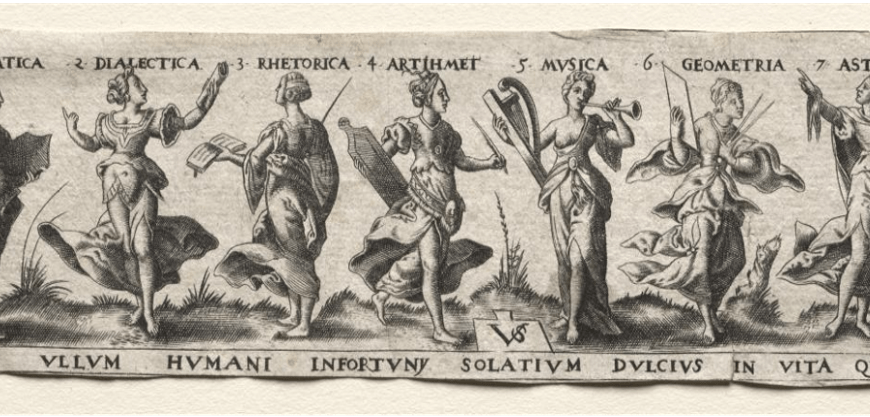
The Centrality of the Trivial: Grammar as a Liberal Art (Explorations in the Art of Grammar Series #6)


The Centrality of the Trivial: Grammar as a Liberal Art (Explorations in the Art of Grammar Series #6)[1] By Anthony G. Cirilla It has often been debated whether grammar is useful when studied “out of context,” though I have my suspicion that few who teach grammar actually envision their project in the classroom as ideally contextless. What would that mean? In absolute terms, the closest … Continue reading The Centrality of the Trivial: Grammar as a Liberal Art (Explorations in the Art of Grammar Series #6)

What’s Your Aim?

What’s Your Aim? By Sara Osborne The midpoint of a semester naturally prompts some reflection, for both teachers and students.  This half-way point often reveals whether a teacher’s fresh plan, new curriculum, or adjusted content has yielded its desired results.  Similarly, students take stock of their performance on class assignments and assessments and consider whether or not their study strategies are working as planned.  Interestingly, … Continue reading What’s Your Aim?

Prometheus or Prodigal? Aristotle on Einstein

By Brianna Kelly, Guest Author What has changed in natural science from the time of the ancient Greeks? The popular caricature sketches ancient science as a primitive, feeble natural fiction with little relevance to today’s students and scientists. In this narrative, Aristotle and the ancients groped stupidly in the cold dark until modern demigods such as Einstein delivered the hidden fire of truth to mortals. … Continue reading Prometheus or Prodigal? Aristotle on Einstein

The Educator as Sherpa

By Jarred Pike, Guest Author In the formidable landscape of learning, students need an advocate who has scaled the ridge for themselves. Sherpas have gained renown for providing specialized support for foreign trekkers and mountain climbers. The Tibetan people who live on the Himalayan slopes serve as apt models of effective teaching in large part because climbers’ lives depend on it. The personal relationship between … Continue reading The Educator as Sherpa

It Sounds Like Singing

By Kelly Garrison, Guest Author It sounds like singing! As a description of sound, singing most often refers to the human voice. Birds chirp and machines whine, but people sing. In terms of creation, people are sacredly set apart and created to know, understand, and seek. For the Children’s Sake reminds us that Charlotte Mason specified children as persons, and in her teachings she respected … Continue reading It Sounds Like Singing

Science, Natural History, or Natural Philosophy: What Exactly Are We Calling It These Days?

By Dr. Brian Polk, Guest Author I recently asked a group of science educators that work for Christian Classical Schools if they prefer the term science or natural philosophy, and I’d like to pause to ask you the same. I prefer Natural Philosophy for a few reasons, and some explication is warranted. However, most of it has to do with the meaning, literal and implied, … Continue reading Science, Natural History, or Natural Philosophy: What Exactly Are We Calling It These Days?

The Case for Classical P.E.: A Practical Application for Upper School

By Jenny Crockett, Guest Author “Pupils develop a well-disciplined attitude toward the ‘hard work principle’ in terms of heavy, energy-output type of activities.” This is a quote from Stan LeProtti’s program guide for the La Sierra High School PE program. He expected his students to do hard things. He took a whole man approach to physical education to produce students who were both physically and physiologically fit, … Continue reading The Case for Classical P.E.: A Practical Application for Upper School

What Are You Looking For? The Crossroads of Classical Education and College

By Wade Ortego, Guest Author Whether it is the numerous startups launching, charter schools clamoring to copy the model with state approval, or mainstream Christian schools seeking to boost enrollment with transitions to the classical curriculum, the classical model is on the rise. After the past two years of lockdowns, online learning, and teacher strikes, families seek something new for their child’s education. While many … Continue reading What Are You Looking For? The Crossroads of Classical Education and College

Teaching as Hospitality 

By Carrie Eben, Guest Author Hospitality might not be the first word for many to describe a posture of teaching. My first understanding of the word hospitality was limited to the act of entertaining guests, and if this is one’s only understanding of the word then a negative response is warranted—the role of the teacher is not to entertain her students. However, this is not … Continue reading Teaching as Hospitality 

Intentional Grammatical Mistakes: Miriam Joseph and Martianus Capella on Bad Grammar (Explorations in the Art of Grammar Series #4)

By Jenna Carey, Guest Author We are immersed with grammatical concepts from the moment we are born to the moment we take our last breath. Our parents bombard us as babies with, “can you say da-da; can you say ma-ma,” then we grow up, leaving “da-da” and “ma-ma” behind, shouting “I love you, I’ll see you at Christmas” on the way out the door. Not … Continue reading Intentional Grammatical Mistakes: Miriam Joseph and Martianus Capella on Bad Grammar (Explorations in the Art of Grammar Series #4)

Joyful Music Literacy & the Classical Christian School Music Teacher

By Jarrod Richey There is a saying, “those who can, do, and those who can’t, teach.” The music educator might be tempted to think that he/she is missing out on the “real” work of music. But we know in the classical movement that education is more about formation than simply imparting information.[1] The honorable place of power and influence is in teaching and mentoring students. … Continue reading Joyful Music Literacy & the Classical Christian School Music Teacher

Teaching, Oblivion, and the Mortification of the Self

By Ian August Mosley, Latin Teacher at School of the Ozarks Most movies are not about teachers. They are not as popular a subject as criminals, warriors, or lovers. Nor do movies about teachers include many scenes of actual teaching. Films cover teaching itself with a demure veil that calls to mind the strict propriety of the golden age of Hollywood. In the old movies, … Continue reading Teaching, Oblivion, and the Mortification of the Self