
What hath poetry to do with natural science? Probably quite a lot, but in this post I want to reflect upon only one feature. Much poetic analysis and teaching makes the same mistake as most teaching of the natural sciences. I’ll get to the answer in a moment.
If I were to ask a student to learn about a frog, how might they go about it? If I were to ask a teacher to teach about a frog, would the teacher go about it the same way? Unfortunately, much modern education would tell the teacher to grab a book and begin communicating facts about frogs. This we might call the Mr. Gradgrind method, from Charles Dickens’ novel Hard Times.[1] The second approach would be to procure a dead frog and dissect it. In both cases, the scientist and educator makes a mistake about the nature of things. In C. S. Lewis’ The Voyage of the Dawn Treader, there is a wonderful scene between Eustace, the boy of science, and Ramandu. Eustace says, “In our world […] a star is a huge ball of flaming gas.” Ramandu replies, “Even in your world, my son, that is not what a star is, but only what it is made of.” Too often we mistake the facts about a thing for the thing itself. A frog is not best understood by facts and dissection. A frog is best understood when one watches it hop and swim and croak in the wild. That is what a frog is; the other education is only what it is made of.
The same can be said about poetry. If the study of poetry is merely an exercise in iambs and meter, rhyme scheme and enjambment, or the typical symbolic meaning of a flower, then we have mistaken what a poem is made of for what a poem is. The only way to truly understand a poem is the same way we must understand a frog–we must observe it in the wild, with the life still in it. If we take a poem and, like the frog, kill it so that we might dissect, we will never discover the wonder of a poem just as we will never understand the wonder of a frog. This is not to say that we may never dissect a frog or a poem, but only that we must experience it alive before the autopsy upon the dead specimen will make any sense at all.
[1] ‘Bitzer,’ said Thomas Gradgrind. ‘Your definition of a horse.’
‘Quadruped. Graminivorous. Forty teeth, namely twenty-four grinders, four eye-teeth, and twelve incisive. Sheds coat in the spring; in marshy countries, sheds hoofs, too. Hoofs hard, but requiring to be shod with iron. Age known by marks in mouth.’ Thus (and much more) Bitzer.
‘Now girl number twenty,’ said Mr. Gradgrind. ‘You know what a horse is.’
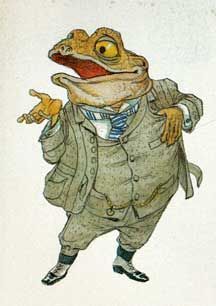
Feature Image: Frog from Kenneth Grahame’s The Wind in the Willows
 The Classical Thistle