
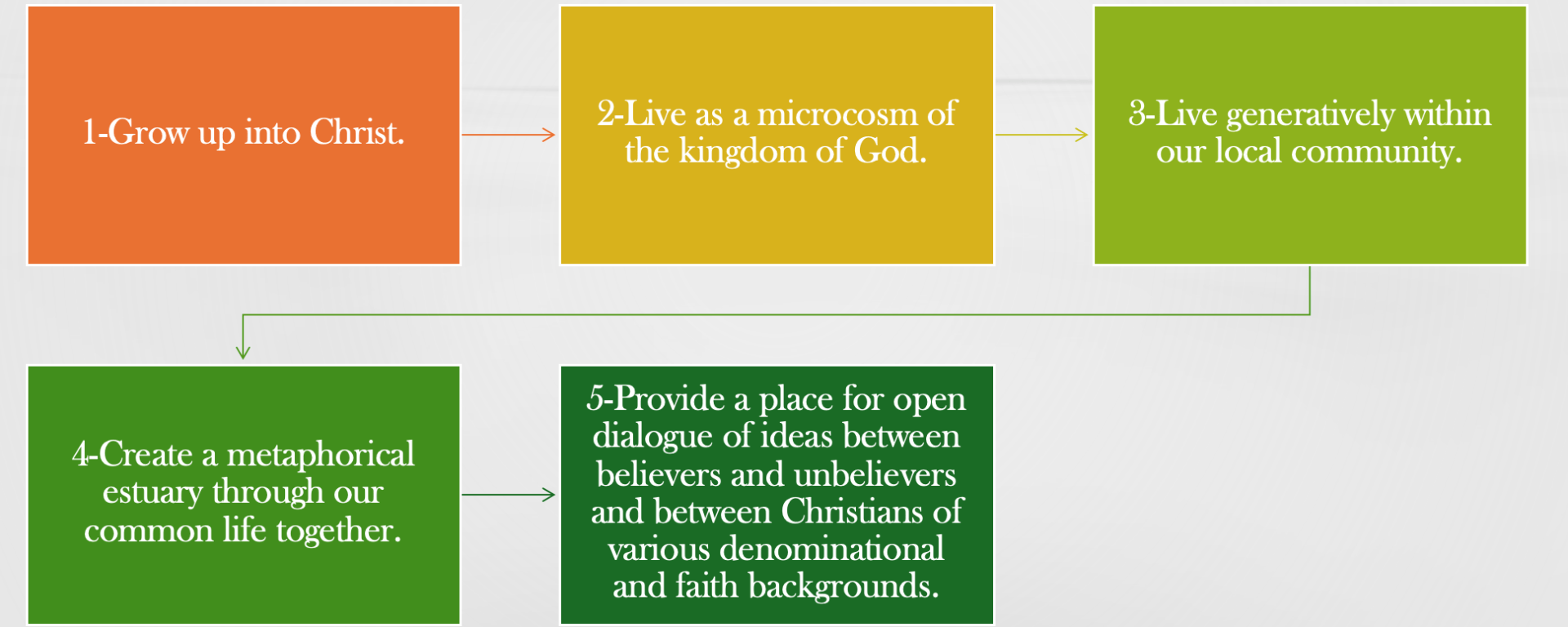
Our 5 Defining Practices, in More Detail (still in progress…)
1-Grow up into Christ.
I began reading Eugene Peterson’s excellent book, Practice Resurrection, in the summer of 2022. As with all of Peterson’s work, I had to read slowly, not because it was difficult, but because it was so thought-provoking. I had owned the book for years, but I was only finally getting around to reading it.
I picked it up during a particularly difficult season of life, a season in which we were pretty sure we were finished or almost finished with our time in the BSU ministry, but God was simultaneously directing my head and heart toward pastoral ministry in ways I never imagined. I had read Harold Senkbeil’s The Care of Souls the previous fall and spring as I reflected deeply on what Jesus meant when he told Peter in John 21 to feed and tends His lambs and sheep. I then picked up Eugene Peterson’s The Pastor and saw in his story some of the deep longings of my own soul. I didn’t know why, but God was laying these things upon my heart. So, during this particularly hard season, not understanding my pastoral vocation and how it matched with where the Lord had us, I picked up Practice Resurrection with the plan of learning more from Eugene Peterson.
At this same moment, however, I was trying to figure out how to make what was likely to be our last year of BSU meaningful and impactful for students. I began thinking about my own faith journey, the seasons in which I experienced the most growth, and what and/or who had impacted me the most and how. I realized how many of the moments of greatest illumination came from ideas I read in books that, frankly, I was shocked I hadn’t heard (or hadn’t connected) when I was growing up in church. How could it be that I grew up in the church, followed Christ from as long as I could remember, but missed some of the most fundamental and foundational truths of the gospel and discipleship? I started thinking how growing up in age and stature in the church did not mean I had successfully grown up in Christ. I began planning a series in which we would look at some of the topics and practices that are key to the Christian faith but that I had missed in the process of growing up in the church. How, in short, could we learn to grow up in Christ?
And then I opened Peterson’s Practice Resurrection; more specifically, I looked at the cover. Practice Resurrection: A Conversation on Growing Up in Christ. Even before I read a word inside the cover, Peterson’s title must have been subconsciously working on my mind. As I began reading, Peterson’s vision for the pastoral vocation and for the faithful life of followers of Jesus gripped me. Working his way through Ephesians, Peterson explores what it means to grow up into Christ. My imagination was reawakened, and my reading of Ephesians was significantly deepened as I reflected almost daily on Peterson’s words.
Metaphorically, The Greenhouse aims to provide worship, ministry events, and rich community that helps each one of us grow up into Christ. I don’t think I will ever fully comprehend the depth of this phrase, certainly not enough to write it out in a short blurb like I have space for here, but I hope that this brief narrative and reflection provides some nutrient-rich soil in which your imagination can, like mine, begin to take root and grow up and bear fruit.
2-Live as a microcosm of the kingdom of God.
One of the marks of Jesus’ preaching is how often he speaks of the kingdom of God. One of the marks of many American churches and much Christian-speak in society is how often Christians speak of heaven. I don’t think we often mean the same thing. For Jews of the 1st century, the kingdom of God meant many things, including God’s fulfillment of His promise to David (2 Sam 7), the overthrow of Roman occupation, the reclaiming of the land of Israel, and the Messianic King on the throne. For Jesus, however, His kingdom came in two stages. He came first to proclaim liberty to the captives and recovery of sight to the blind; He came to demonstrate for us perfectly what God is like and what being truly human is like; He came to overcome death; and one day, but not yet, He will come again and fully establish His kingdom.
Yet despite this two-part kingdom, Jesus did not teach us to sit idly, staring at the skies for His return. In fact, just moments after His ascension in Acts 1 the disciples are doing just that, looking into the sky, when angels remind them that there is work to do. That work involves making disciples (Matt 28), fulfilling the Great Commandment in our relationships with others and God (Matt 22), and servings as God’s ambassadors to be ministers of reconciliation to a lost and broken world (2 Cor 5). These tasks are immensely difficult, a reality that Jesus reminded His disciples of over and over. It was a life of service, self-sacrifice, compassion, love, and forgiveness; it was a life carrying a cross.
But Jesus did not leave His followers without hope. He gave authority, power through the indwelling Holy Spirit, and instructions. In Jesus’ sermon on the mount in Matthew 5-7, Jesus teaches many important things about Christian discipleship. Among the more prominent come in his model prayer. Within this prayer are some significant words: “Your kingdom come, Your will be done, on earth as it is in Heaven.” Notice first, it is possible to talk about kingdom and heaven; my point earlier is that we often ignore kingdom for (often unbiblical) versions of heaven in the clouds. The prayer, however, makes clear that we await the return of the King and His kingdom as it will be in its fulness. In the present, then, we pray that God’s kingdom will come, characterized by His will being done on earth without opposition (i.e., as it is in Heaven).
The practice of living as a microcosm of the kingdom of God, then, is to be a faithful community that lives out God’s will on earth as it is in heaven, surely an appropriately biblical but lofty goal. We want our community to be saturated with freedom from sin, addiction, hate, and prejudice, and filled with freedom to do God’s will, love, compassion, and generosity.
3-Live generatively within our local community.
What does it mean to live generatively? The word generative has the basic meaning of being capable of producing or creating. In recent years, Makoto Fujimura has used the word in conjunction with his project on culture care to speak of bringing forth “resourcefulness, patience, and general creativity in all of life. They lead to cultural–and human—thriving.” Fujimura highlights three aspects of generative thinking. First, generative thinking arises out of genesis moments. We can learn to discover such moments by assuming that every moment is fresh. Second, generative thinking arises out of generosity. We are reminded that “life overflows our attempts to reduce it to a commodity or a transaction—because it is a gift.” Third, generative thinking arises out of “generational blessing toward creativity.”
To live generatively within our local community is to foster an environment where each person can use his or her God-given creativity to find new ways to benefit others within the community. These creative acts are gifts to the community that, as the definition of generative suggests, are capable of producing or creating further acts of generosity. Each generative act can become a genesis event that initiates the generative act of another, creating a ripple effect of creative, communal acts that bless the culture around us. This is why part of our mission is to live out the Christian faith in generative ways that provide a broken world glimpses of the kingdom of God as it will one day be in its fullness. Each generative act is a reflection of the creative and redemptive work of God.
4-Create a metaphorical estuary through our common life together.
“Of making many books there is no end, and much study is a weariness of the flesh.” (Eccl 12:12b).
The multiplication of books does not inevitably lead to the multiplication of wisdom—or disciples. And it is the multiplication of disciples for which we are laboring. In recent years, the number of books on discipleship have certainly multiplied, but I’m not convinced the number of disciples have multiplied accordingly. At best we are working with simple addition. At worst we are subtracting. So why, with such a proliferation of books on discipleship, are we not seeing the multiplication of disciples? The reasons are almost certainly multi-faceted, and I am neither wise enough nor thorough enough to explore them all. But recently I have been thinking about how often books on discipleship, as well as conference talks and sermons, suggest a new model. What if, however, we didn’t need a new model but a new perspective?
Several years ago I was reading Makoto Fujimura’s excellent book, Culture Care. In one particularly insightful chapter Fujimura discusses cultural engagement through the analogy of an estuary. An estuary is a partially enclosed body of water near a coast that serves as a transition area between river and maritime environments. An estuary connects to the open sea on one side and has one or more rivers joining it on the other. The mix of fresh and salt water provides a nutrient rich environment that offers the necessary conditions for some of the world’s most diverse and productive natural habitats. For Fujimura, the estuary illustrates the dynamic, multi-faceted lives that interact with one another despite radically different characteristics.
When it comes to discipleship, however, we often use more linear and compartmentalized models. We tend to think of discipleship within homogenized communities of like people. Collegiate ministry, which Kristin and I have been directly involved in for more than eleven years, is perhaps in most danger of this approach as we tend to have a very narrow age range of disciples, easily presenting the idea that most students are more or less similar types of people because they are in similar stages and contexts of life. Likewise, we tend to think of discipleship in more linear patterns, presenting discipleship models that are easily drawn with arrows or branches from a single source. But as I explore Jesus’ own practice of discipleship, it’s difficult to see how many of our models reflect in any meaningful way what Jesus Himself did. Jesus moved easily from Pharisees to Samaritans, children to adults, tax collectors to prostitutes, men to women, and many more. I think this was possible because Jesus saw His mission field as a living, breathing estuary; it was a mixed habitat that provided the context that fueled the lives of saints and sinners and everything in between.
So, what might it look like to view discipleship as a living estuary rather than a lifeless line-chart? We’ve been prayerfully seeking to live this out and figure it out along the way. In the summer of 2021 I worked to build Christian community through two reading groups and a writing group consisting of friends, family, acquaintances, and current and former students. One group had my dad in his sixties, a middle-aged woman, several 30-40 year old men, a few recent college graduates, and an 18-year old recent high school graduate. Another group had a 30-year old sound technician at a Branson show, math, music, and history professors, and a couple of former students. My writing group was even more mixed with a homeschooling mom who writes children’s books, a mom trained in TESOL and interested in classical education, a former music professor, a campus minister who likes poetry, and so on. Then, of course, my wife and I are discipling our three children, I have met routinely with a local church’s worship pastor, our former BSU assistant director, and two former students, and we are trying to build strong community with a couple families. We have regular conversations with neighbors in the subdivision we moved into right before the pandemic, some of whom are Christians and some who are not, and try our best to serve a couple of Christian families who are friends of ours who live a few houses further away. Oh, and my brother and his wife live two blocks from us. And here is the point—for several years I went to campus to do a lot of our BSU ministry, but we have always built our ministry around inviting people into our home regularly. And what we have found is that the time people spend in our home is what has proven most impactful. Late in June we had a former student come to our house who is about to finish her third year as a missionary in Germany. She told us that the conversations we had at the kitchen table over bagels or while we were putting our children to bed were some of the best moments of her time in the BSU ministry. Moreover, when people come join us in our home, they see and hear about the reading groups, the neighbors, and learn that all of life is lived out in our Christian vocation, not just the hours I clock in as a teacher or collegiate minister.
We don’t always (or maybe ever) do this well, but we try to do it. And I am more and more convinced that faithful Christian discipleship looks a whole lot more like the living, breathing, diverse estuary than it does a homogenous ecosystem for a few goldfish. If you want to do discipleship well, then do discipleship everywhere and with everyone. If you want discipleship to be effective, it’s not a new model, or a new program, or a new discipleship tree or map or graph—it’s about creating a diverse ecosystem where people of all ages, races, interests, and personalities can grow and flourish.
5-Provide a place for open dialogue of ideas between believers and unbelievers and between Christians of various denominational and faith backgrounds.
Open dialogue requires open-mindedness. If we cannot know fully, then we cannot be unnecessarily dogmatic regarding those things about which Scripture and the Church have not spoken definitively. Nothing squelches the growth of wonder quicker than closed-minded, dogmatic thinking and claims of certainty. A person confronted with such attitudes from another believer are left with two options: 1) prideful claims to certainty and complete scientific knowledge or 2) rebellion. Even if a believer is right about the alternative options that another has dismissed, forcing rebellion is harmful for the individual. Instead, our churches and Christian communities should be fostering an inquisitive spirit. If we have pre-determined that certain questions cannot be asked, or that there is a single way of approaching a question, or that there is only one possible answer when, in fact, more than one presents itself as possible (or even plausible), then we will foster a closed-mindedness to the world that assumes our learning and theology is merely about “scientific” or exact knowledge. Rather, we hope our community will be characterized by an open-minded, truth-seeking, goodness and beauty-producing dialogue.
 The Classical Thistle